experiments with claude, part ⅱ: my personal site
I’ve been trying more things with Clade Code, and I want to keep some notes on how it went. This is the second post in a probably-short series about early adventures with the tool.
Project Two: rjbs.cloud/talks
I felt good about how the Cassandane subroutine signature replacement went, and I wanted to do some more experimentation. This time, I wanted to use Claude to generate code that I wouldn’t just go delete. I wanted something low stakes, where I wouldn’t have any reason to feel annoyed by Claude’s choices in implementation. I also wanted to be able to say “yeah good enough” when I thought it was good enough, without asking anybody else to accept that the work was good enough for the repo. That is: I wanted an isolated test case where only I was taking on any risk. Easy: my personal web page!
Sure, in theory this was using company resources (my Claude subscription) for personal use, but I already got Fastmail’s $20 worth out of Claude in Cassandane. And it was professional development. Yup, felt like a great idea!
Did I mention I was in Belgium at the time? I was. I was at FOSDEM, I’d just given a talk on JMAP, and I was going to put it on my “talks I’ve given page”, but that page of my site was still on my old website, where it was manually-written HTML. My current site is Jekyll, built by GitHub Pages, the definition of “good enough”. By hand, I got the talks page into Jekyll, as a horrible hybrid of Markdown and the old HTML. You can read the state I got it into in the last commit before I invited Claude to the party.
I prompted Claude with this:
The file
talks/index.mdcontains two lists of conference presentations. One is a Markdown bullet list of links, generally to YouTube. The other is HTML with thumbnail images linked to SpeakerDeck. Convert this to a data-driven grid rendered by Jekyll, presumably using a collection. Each entry should be able to contian a text description, title, and image asset.
If you want, you can read the entire, highly-detailed transcript of this session with Claude. The short version is that I spend about 20 minutes engaged with Claude. (There are some hours-long waits in there while I did things like “go to dinner”.) Claude very quickly updated my repo to do just what I asked. It looked pretty good, too, and produced a pretty straightforward commit. The commit message is crap: I wrote it, with an audience of “myself”.
The commit adds a bunch of CSS (SCSS), which very plausibly contains pointless crap or is doing in a goofy way. I don’t know because (a) I’m not a CSS expert and (b) I could not care less. This kind of “could not care less” echos my feelings about the construction of the throwaway subroutine-signature-adder. This code (the CSS) would stick around, but I wasn’t going to have to think about it. The real content was the YAML file, and if the CSS got too complicated later, I could throw it all away, start over, or whatever. It was not for human consumption, and posed roughly no risk. (I did read it, because no LLM-generated code is obviously safe and correct.)
With that done, things got more interesting, in that there was more faffing about. For a talk with slides and an image, I was going to have to do this:
/_data/talks.yaml   # <- add an entry
/asset/talk-name/preview.jpg
/asset/talk-name/slides.pdf
Ugh, there was too much chance of anomaly there. I asked for a fix, Claude said “What if we use a collection?” and I said, “That’s what I suggested to start with!” Still, Claude went ahead and converted the talks.yaml file into a bunch of individual Markdown files for me, so all was forgiven. Then there was a big back and forth about how to make preview image discoverable, where Clade was definitely confused about how things worked.
static_files?site.static_files. They might be in a different collection-specific variable, or might need to be accessed differently.This was really frustrating, but only about 70% because of Claude. The Jekyll docs are beautiful but lousy. They sort of vaguely describe how things work in many cases, but they’re hardly comprehensive. We got there in the end, but it was tedious: I took over, made changes by hand, pushed, and checked what happened.
Project Two ½: rjbs.cloud/talks refactoring
After the previous day’s mix of success and annoyance, I went back for round two. I did a few things. I cleaned up some old posts, I reworked how the talk source files were laid out… but the main thing was I got a local build running. This was never going to be hard, because I’d done it before, but I didn’t want to futz around. I asked Claude how I could get a local build going and it said “like this” and dumped out a little shell script. I didn’t like it and asked for a few improvements. Within minutes, I had a local build-and-serve script committed.
You can read the whole transcript, boring bits and all. Also, of course the commits are all in my repo.
Was this safe to run on my laptop? Well, I think so.
Claude’s general tool-running security is pretty lousy. It says it won’t touch stuff outside the project directory, and tries to ask for permission, but it’s pretty unintelligent. When in doubt, throw it all in a container. Anthropic offers some. But there’s also sandbox mode. In sandbox mode, Claude uses bubblewrap or seatbelts, which are effectively process namespacing tools. In sandbox mode, you can tell Claude to go ahead and try whatever it wants. If the kernel prevents it, then it will ask permission. This isn’t a foolproof system, but it’s suitable for “hackin’ on my personal website”.
Project Two ¾: rjbs.cloud hacking on the web
Last bit about using Claude for my personal site!
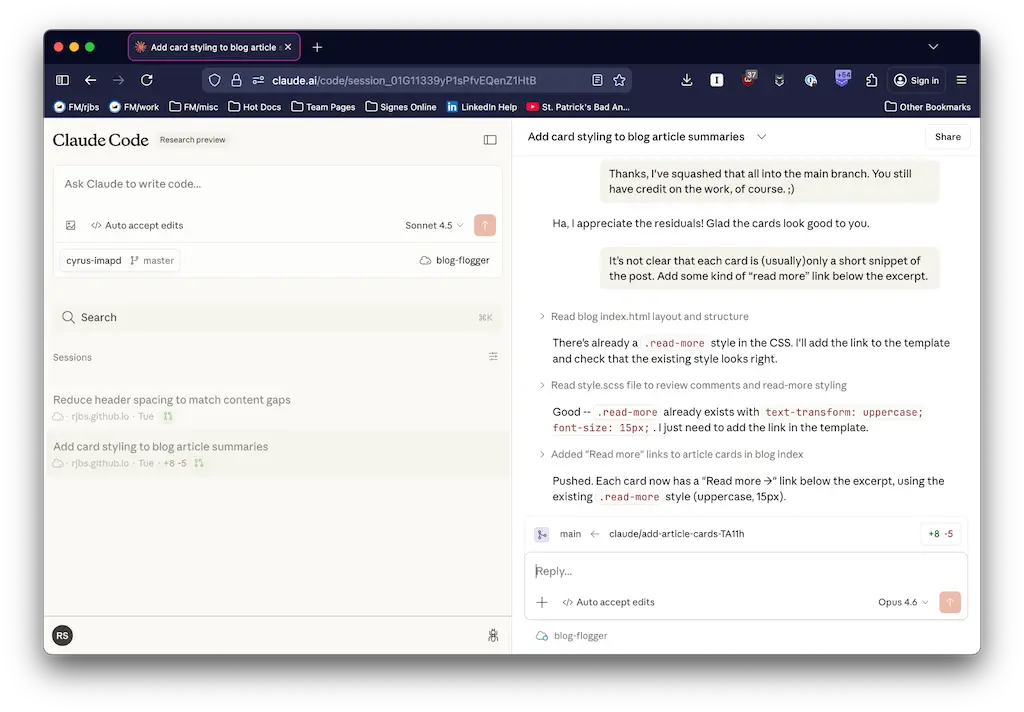
My friend David is much more of a power user of Claude than I am. The other day, he said he was kicking off some bugfixes from a taxi. I said, “How does that work?” It’s like this: Just like you can chat with Claude in your browser and ask it to explain how an octocoupler works, you can code with Claude and ask it to make changes to your software. It’s like an IDE, but there’s no human-operable editor. (Kind of like emacs, heyooooooo!)
You give Claude permission to access your GitHub repos, and it runs its edits and other tool use inside Anthropic’s compute cloud. When it’s done, it can create PRs for you.
I am not enthusiastic about this setup, although “fire off a worker to get started on a problem” is not a bad idea. It’s mostly that Claude Code on the Web is pretty limited and I don’t think it will be suitable for my primary work any time soon. Also, I’m less clear on the entire security model of delegated GitHub access through Claude. I need to really read the docs, here.
On the other hand, I fixed a bit of styling on my blog from a chat on my tablet. This all fell under “pretty neat, worked great, not interested”.